
2024 Moss Wood Semillon 750ml
$43.64 per bottle
$43.64 per case of 12
Wine Finder
Let's find your perfect pour.
Whether you know exactly what you want, or need a little guidance — we've got you.
What kind of wine are you in the mood for today?

Or choose one of our suggestions below:
Or pick one of our favourite regions:
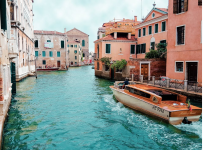
424 wines

680 wines
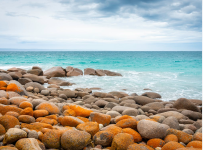
660 wines

55 wines
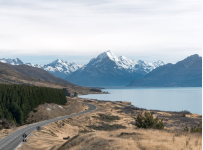
146 wines
Close

Closure: SCREWCAP. Case Size: 1.
14%
1500ml
$94 .23
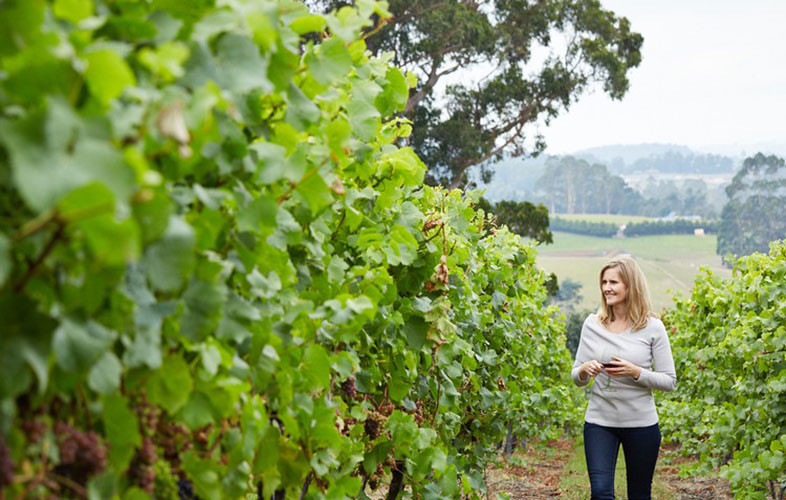
A pioneering Estate in Margaret River’s northern sub-region, Wilyabrup, Moss Wood was first planted in 1969 and has slowly risen to icon status in the eyes
<p> </p> <p> </p> <p><img src="http://www.fesq.com.au/images/brands/85MOSS%20WOOD%20LOGO2.jpg" alt="moss wood" width="378" height="226" /></p> <p>Moss Wood is a premium wine producer located in the Margaret River Wine region of Western Australia. The area is regarded as one of Australia's premium grape growing regions.</p> <p>The wines produced at Moss Wood are Cabernet Sauvignon, Pinot Noir, Chardonnay, Semillon and from Moss Wood's Ribbon Vale Vineyard, Semillon Sauvignon Blanc, Cabernet Merlot and Merlot. There is also a Cabernet Sauvignon, Petit Verdot, Malbec, produced from grapes sourced from Yallingup and Cowaramup and since 2008, a Moss Wood Mornington Peninsula Pinot Noir, produced from grapes sourced from that famous Victorian region.</p> <p>Proprietors Clare and Keith Mugford enjoy the challenge of consistently producing high quality wines at Moss Wood. All decisions made in the vineyard and winery are based on the effect they will have on the quality of the wine.</p> <p><strong>Moss Wood History</strong></p> <p>A paper by viticulturist, Dr John Gladstones, first drew attention to the suitability of the Margaret River region for making wine. Gladstones believed that the soil found in the area, clay subsoil covered by gravelly loam, was ideal for viticulture. He compared the Margaret River climate with that of Bordeaux, indicating that both had an average rainfall of over 1000mms and an absence of temperature extremes, because of the influence of the sea on three sides.</p> <p>One of the first to be influenced by Gladstones' theory was Bill Pannell who spent six months searching the Margaret River area for ideal land for a vineyard. He chose a site at Wilyabrup and persuaded the owner, Jack Guthrie, to sub-divide his land and to sell the block, which became Moss Wood.</p> <p>Bill and Sandra Pannell commenced work on the Moss Wood Vineyard in 1969 at the same time as the Hohnens were developing Cape Mentelle and just two years after Dr Tom Cullity began the first vineyard in the area at Vasse Felix. A nursery for Cabernet was established in 1969, and the next year, two hectares of Cabernet Sauvignon were planted.</p> <p>The first vintage took place in 1973 when 250 dozen bottles of Moss Wood Cabernet Sauvignon was made. The Moss Wood Pinot Noir was first produced in 1977. Semillon was the first white wine planted at Moss Wood because suitable cuttings of Chardonnay did not become available in Western Australia until 1976. The first crop of Semillon was harvested in 1976, although a commercial release was not possible until the next vintage. Similarly, the first vintage of Chardonnay, in 1980, was not released commercially and as the next two crops were destroyed by bad weather, the public did not see a Moss Wood Chardonnay until the 1983 vintage.</p> <p>In 1978, Roseworthy graduate, Keith Mugford, was employed to run the winery. After completing a Bachelor of Applied Science in Oenology at Roseworthy College in South Australia and then vintages at Tullochs (1977) and Orlando (1978), Keith began making wine at Moss Wood with the 1979 harvest. Clare Mugford started her working life in banking and then as a Registered Nurse at Royal Perth Hospital. In 1984, the newly married Mugfords leased the Moss Wood vineyard and winery and became managing partners. During this year the sale of the property was negotiated and in July 1985 the Mugfords assumed full ownership. It has been, and continues to be, an interesting and challenging journey for both of them.</p> <p>The following decade saw significant developments including re-trellising, in line with new developments in vine management in Australia, and the planting of Cabernet Franc, Merlot and Petit Verdot for blending with the Cabernet Sauvignon.</p> <p>In 1989 Ian Bell, was appointed Vineyard Manager after working at Moss Wood from 1985 to 1987 and then studying at Roseworthy College where he qualified as a viticulturist. In 1998 Ian moved into the position of Assistant Winemaker.</p> <p>THE NEED FOR EXPANSION - THE PURCHASE OF RIBBON VALE VINEYARD</p> <p>In planning a successful future for Moss Wood, Clare and Keith had to consider a range of interests, some of them personal, some professional and all of them challenging.</p> <p>They would like to see Moss Wood continue as a family business but there are now four Mugford children. While it is too early to say if any will be involved, it is important for the business to be large enough to accommodate all their interests, should all four be keen to work in the company. Moss Wood in its original form was too small to do this.</p> <p>Furthermore, the organisation was faced with the prospect of losing some of it's key people because as a small business, it was unable to offer a continuing career path. To lose excellent staff under these circumstances would represent a risk to the company's future, especially if there was no interest from the next generation of the Mugford family.</p> <p>In addition to these issues, Moss Wood has had to come to terms with its place in the global wine market. It now has customers all around the world. This has increased the number of people seeking to buy its products and changed the price points at which they sell. This has affected the Cabernet Sauvignon in particular, which has risen significantly in price. Within the Australian market this has been a source of frustration for many consumers who were still keen to purchase a Moss Wood wine but found the price too high. Moss Wood did not have a product available to fill this void.</p> <p>Furthermore, demand for outstanding quality table wine of any colour but especially red, has never been higher. The opportunity to take advantage of consumer interest was simply not there because the Moss Wood vineyard is so small. It was therefore necessary to look at alternatives and herein lies a crucial point: the key to success with Moss Wood has been that its wines are produced from only one vineyard. This has ensured the consistency of style and quality for which the brand is famous.</p> <p>There is also an important philosophical point here. Clare and Keith were very aware that Moss Wood should not rest on its laurels or become complacent. The challenge of expansion was seen as important in maintaining this.</p> <p>Given the above requirements, what were the options?</p> <p><span class="highlight">Option 1, Establish a New Vineyard</span></p> <p>Using a careful and analytical approach, it would be possible to find a new location that shared similar characteristics with Moss Wood ie gravelly loam soils on a north-facing slope, in the Wilyabrup region. However, very few of those properties exist and even fewer are available for the planting of vines. Furthermore, even with a careful search, wines produced from that property could not be guaranteed of having the necessary quality to be blended with Moss Wood.</p> <p>With that being the case, a new label and brand would need to be developed, a slow and expensive process given that it takes six years just to bring an unirrigated vineyard into full production and a further two years before the wines could be sold.</p> <p><span class="highlight">Option 2, Purchase an Established Vineyard</span></p> <p>The purchase of an established vineyard, with its own label, was a more attractive prospect for two important reasons:</p> <p>1. It is in full production, contributing to the profitability of the business immediately.</p> <p>2. The quality and style of the wines are already clear.</p> <p>This last point is significant in another way because it is generally agreed within the wine industry that old vines produce better quality than young ones, so, in the medium term, an established vineyard would hold a quality advantage.</p> <p>The wines would be different from those grown at Moss Wood. However, the winemaking team could bring their traditional approach to bear and put a "Moss Wood stamp" on the products.</p> <p><span class="highlight">Ribbon Vale in The Frame</span></p> <p>Clare and Keith were long-time admirers of Ribbon Vale, an eighteen acre vineyard, planted in 1977, in the heart of Wilyabrup. It was run in the traditional way, just as Moss Wood is unirrigated, hand-pruned and hand-picked. While it is planted on a southwest-facing slope, its soils are the classic gravelly loam over a clay sub-soil, responsible for the best table wines in the Margaret River region.</p> <p>Its plantings were an interesting mix of Cabernet Sauvignon, Semillon, Merlot and Sauvignon Blanc. These last two are not planted at Moss Wood and provided new winemaking challenges. They were also useful additions to enhance the portfolio of wines because they had proved to be of significant quality, with the Sauvignon Blanc being a wine show trophy winner.</p> <p>Another interesting point about the vineyard was that the Cabernet Sauvignon clone at Ribbon Vale is different to that grown at Moss Wood. This would ensure that the wines from the two properties would remain individual and distinctive.</p> <p>Since Ribbon Vale offered such useful opportunities, in 1998 the Mugfords approached John James, the owner and original developer, to discuss the possibilities for the future. Over the next two years, a deal was hatched which saw the property change hands in March 2000, just in time to make the 2000 vintage.</p> <p><span class="highlight">Changes in the Vineyard</span></p> <p>The primary objective of the Moss Wood team is to develop an understanding of the new vineyard. In particular, we need to learn what the appropriate yield levels are for quality wine from each of the varieties. It is also necessary to understand the fruit flavours of each variety and what level of ripeness will maximise them. The further we move away from the year 2000 the more experience of grow <p>This is a very attractive and drinkable vintage and it will certainly provide enjoyable early drinking. However, using the 1976 vintage as our example, we strongly recommend that those who have the opportunity to cellar the wine should do so.</p>
$43.64 per bottle
$43.64 per case of 12